By James Cavuoto, editor
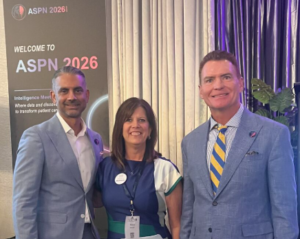
September 1, 2026 | Earlier this summer, Medtronic announced that it completed its acquisition of SPR Therapeutics, Inc., the Cleveland, Ohio, manufacturer of peripheral nerve stimulation systems for treating pain. The acquisition is valued at $650 million. NBR editor James Cavuoto sat down with SPR founder and CEO Maria Bennett at the recent meeting of the American Society of Pain and Neuroscience in Miami.
James Cavuoto: First of all, congratulations on the acquisition. How does it feel now to be part of a bigger organization?
Maria Bennett: It feels amazing. I’m so excited about this next chapter for us. It’s going to allow us to reach more patients. It’s going to allow our team to flourish. Medtronic is the absolute right partner for us. They are aligned to that patient focus that we have, aligned to our culture, and now we’re part of the broadest pain portfolio of any technologies that are out there.
JC: What does the acquisition say about the potential for the PNS market in general?
MB: I think it’s a validation. You see Medtronic investing in this area; we’ve seen Boston Scientific invest in this area with Nalu Medical. It’s a validation that this market has arrived. We were one of the first to build this new market, and now we’ve treated over 58,000 patients. We’ve been able to grow this market significantly, treating many different areas of peripheral pain. And we’re just scratching the surface—there’s so much opportunity in front of us.
JC: Do you think the deal would still have occurred, if not for the Nalu/Boston Scientific deal?
MB: Absolutely. It was totally independent.
JC: As a biomedical engineering graduate from Case Western Reserve University, I’m always gratified to see commercial successes emerge from my alma mater. In the early days of our publication, we reported on a $42 million deal for pudendal nerve stimulation developed by Warren Grill, then at Case, between Medtronic and NDI Medical, which was led by my classmate Geoff Thrope. Could you say a little about how that deal may have played a role in SPR’s success?
MB: Yeah, a lot of the investors that experienced the proceeds from that sale did reinvest into the NDI Healthcare Fund, which had portfolio companies, including SPR and Checkpoint Surgical
JC: You’re not the only woman CEO of a neurotech company that we have covered in our publication—Niamh Pellegrini was CEO of Autonomic Technologies before its unfortunate demise, and Laura Tyler Perryman was CEO of Stimwave Technologies, but we’re not going to talk about Stimwave. So it’s probably safe to say that you’re the most successful woman CEO of a neurotech firm to date. What advice would you offer woman entrepreneurs—especially woman engineers—who would like to mirror your success?
MB: You can do it. Stay true to the culture and the dedication to the team, and lead by example. I always say we should check our titles at the door, but respect each other’s roles and responsibilities. Don’t take ourselves too seriously. Hire better people than you are, to grow that team to expand. I’ve been very fortunate that I’ve had great advisors, a great team around me. I’m a life-long learner, so I don’t try to pretend that I know things that I don’t know.
JC: Did you encounter any barriers along the way as a woman that a male CEO might not have?
MB: Geoff [Thrope] said to me when I first took on this role, “You’re going to face a difficult situation because of your age and your gender.” And when he said that, I was a little offended. But what he was trying to warn me was that I might have a difficult time attracting experienced board of directors, or team members, because I was a first-time CEO. I’m a young woman—I was 36 at the time with two young children—so I said to him, “I can’t do anything about either one of those things. So I’m going to build a company and a product that hopefully inspires people to be a part of this team and a part of this board, and we’ll go from there.” Yes, there were challenges along the way, especially with financing and funding. Traditionally, investors like CEOs with a long track record, or maybe those that are in California or those that are in New York. So to be in Cleveland, to be a first time CEO, to be a female, to be an engineer—there were some early funding challenges. But we got some early grants from the NIH and the DOD, and that really planted the seeds that we needed to get the company off the ground.